You are in the preview mode Exit preview mode
· Update · 5 min read
DataPacket 2025: a powerful product, a powerful year


It's time to wrap 2025. It’s been a fantastic year in terms of our network's expansion and new features. In this article, you’ll find an overview of the year's key highlights, a summary of the most important changes in your client panel, and the answer to the one main question you’d expect to find in an annual rewind: how much has DataPacket grown in the past 12 months?
Ready? Let’s dive into it.
TL;DR
- New DCs: 8 new locations live, adding to a total of 63 locations worldwide
- Network: 290+ Tbps total network capacity & 37+ Tbps private backbone capacity
- Platform & hardware: Additional automation features & more functionality
Coverage: 8 new locations
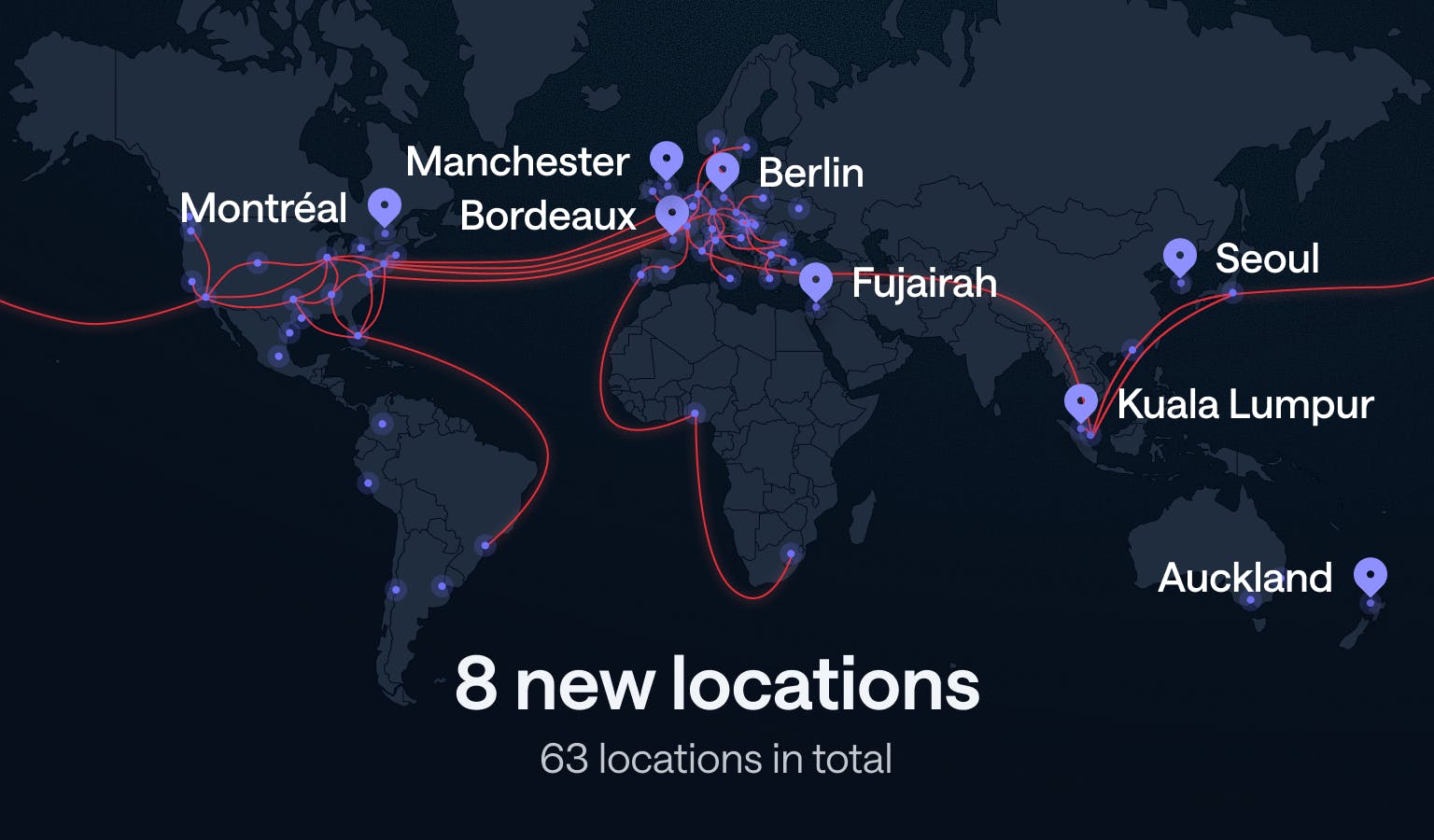
Further expanding into the places where your end users are continues to be one of DataPacket's core goals. In 2025, eight new cities joined our robust worldwide network. You can now deploy servers in Auckland, Berlin, Bordeaux, Fujairah, Kuala Lumpur, Manchester, Montréal, and Seoul. That means you can now choose from 63 locations worldwide. You can browse all of them on our data center page.
All the new locations uphold the same high standards we've always delivered: unparalleled connectivity, excellent uptime, and advanced security. Despite our growth, nothing has changed when it comes to quality.
Network: a road to the ultimate global connectivity
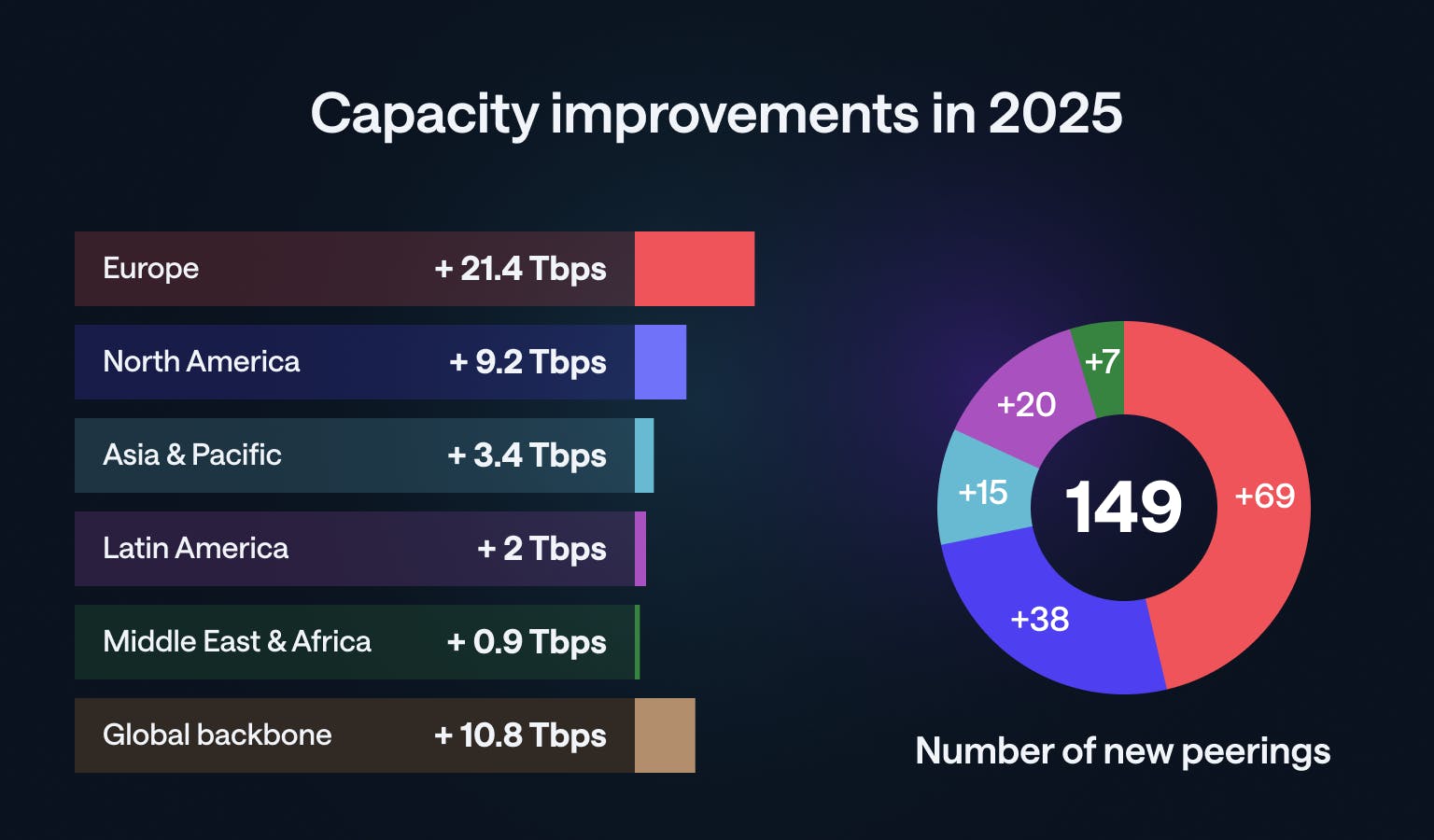
Very few infrastructure providers can back their service with a truly global, low-latency network and best-in-class local routing. That's exactly what DataPacket stands for. Throughout the year, we established 149 new connections with top transit providers, private peers & IXPs across all populated continents.
Platform & Hardware: a leap forward
New features
Throughout 2025, we evolved the client panel and API into an even stronger control plane for your infrastructure, focusing on deeper automation, visibility, and day-to-day ops. Here’s an overview of the key upgrades we implemented this year:
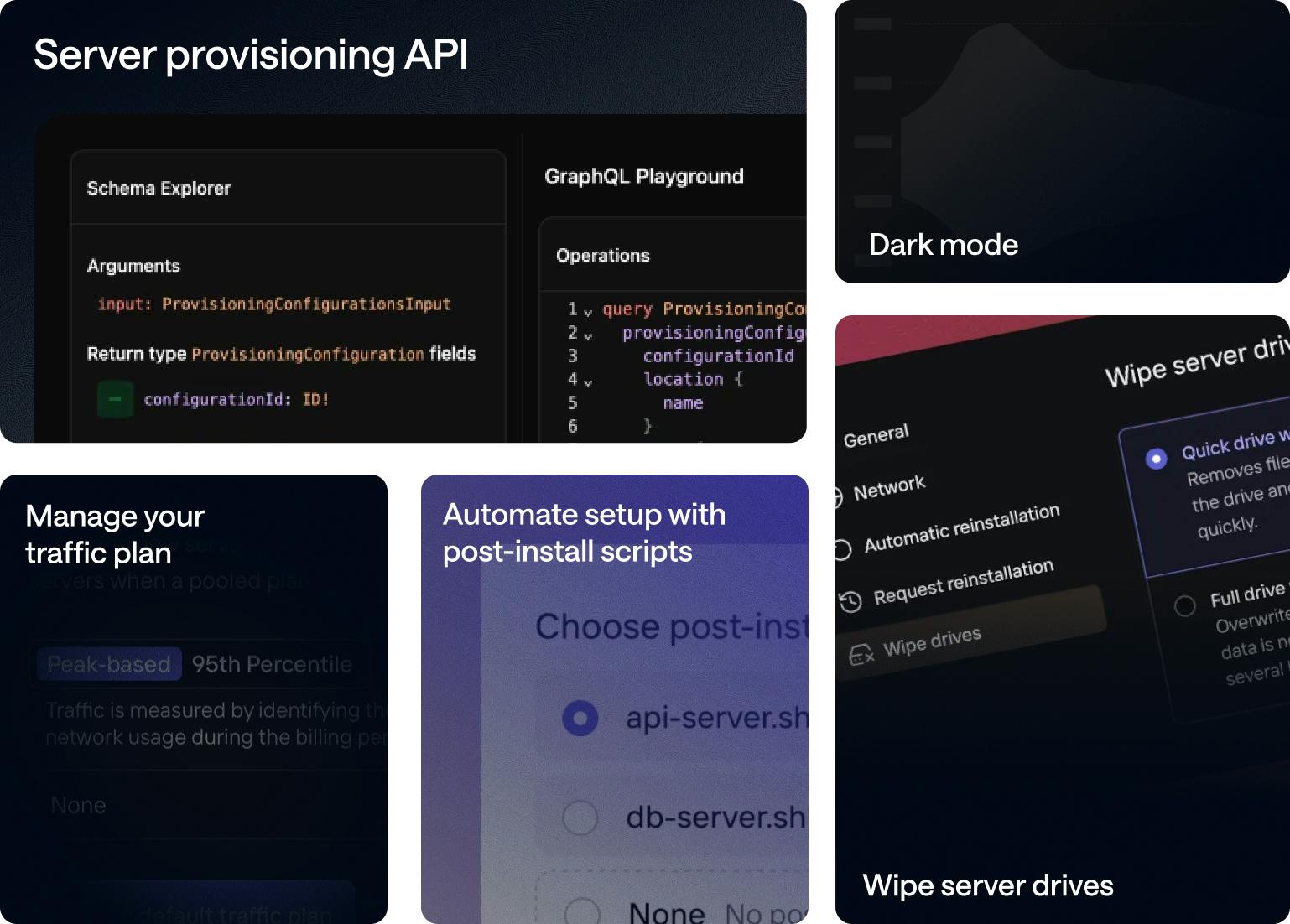
- Server provisioning API – Provision servers via GraphQL with your preferred configs, OS, SSH keys, post-install scripts and monthly or daily billing to fully automate deployments.
- Post-install scripts – Run your custom scripts automatically after installation to standardize setup, with status and exit codes included in your email.
- Link aggregation controls – Enable or disable LAG during deployment, reinstall, from the Network server section, with IP and DNS settings managed in one place, or via GraphQL API.
- Server drive wipe – Trigger quick or full drive wipes directly on the Manage server page, with an email confirmation once the process is done.
- GraphQL Playground – Explore, test and refine GraphQL queries and mutations in a safe UI before integrating them into your tooling.
- New per-server traffic statistics – Fetch granular per-server traffic data alongside aggregated stats in a single GraphQL query.
- Server filtering – See all active filters as removable badges and use clickable tags in the Servers overview window for instant tag-based filtering.
- Dark mode – Use the client panel in dark theme, following your system preference or a manual setting.
- Default traffic plans – Set a default traffic plan in Provisioning settings so it’s pre-selected for new orders and used by your provisioning workflows.
Note: You can keep track of all new releases in our newsletter and in the client panel → Changelog.
Bestselling processors of 2025
CPU of the year – AMD EPYC 4244P
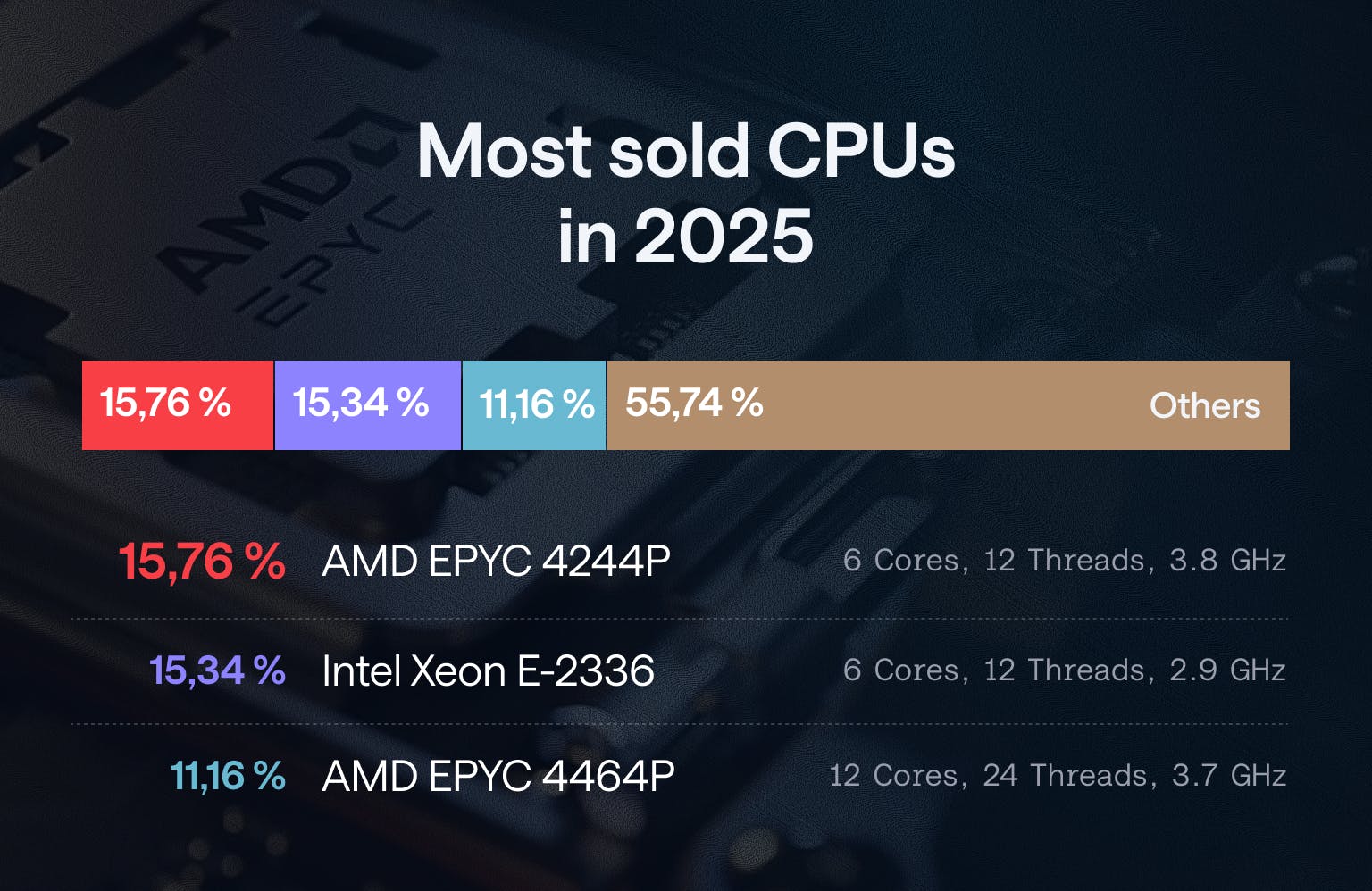
In 2025, we provisioned 15 803 new servers, or 321 218 CPU cores for the stats-crunchers. Our most-sold CPU award goes to the AMD EPYC 4244P (6 cores @ 3.8 GHz), contained in 15.76% of new orders. Right at its heels: the Intel Xeon E-2336 (6 cores @ 2.9 GHz) at 15.34%. Both are chips that sit in the “just right” zone for customers who prefer to split their workload across multiple smaller servers instead of piling everything onto one big machine. They deliver decent single-core performance without the price of the extra cores you will not use, and are easily scalable. For more heavy lifting, however, there were far more popular choices up the stack like the AMD EPYC 4584PX (16 cores @ 4.2 GHz), the bestselling CPU among the models we introduced in 2025, or the AMD EPYC 7443P (24 cores @ 2.85 GHz), a proven, go-to all-rounder across diverse workloads.
Customer stories
We are proud of what we build. But seeing you succeed with it, that’s what really matters. We carried on our mission to share customer success stories and released two new case studies this year:
- Ringover - powering AI-driven, workload-heavy telephony systems
- DatHost - scaling global game hosting for fast-growing multiplayer communities
If you’re a DataPacket client and have a success worth spotlighting, let’s make it heard. Contact your account manager, and we’ll craft a story highlighting your results and the network behind them.
Road ahead
That’s it for 2025! On behalf of the entire DataPacket team, a massive thank you goes to everyone who was part of it. The growth would not have been possible without the unwavering trust we received (and, hopefully, we repaid with reliable service and support!) As we kick off 2026, we are already preparing for the next wave of infrastructure and platform improvements and look forward to having you with us.
Stay tuned and take care!
About DataPacket
Founded in 2014, DataPacket is a dedicated server provider operating a global low-latency network. With a footprint of 67 locations across 6 continents, DataPacket helps businesses–including gaming and video streaming companies–to deliver great online experiences.